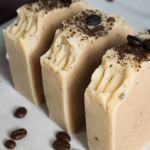
Coffee Tallow Soap
This nourishing bar of soap uses coffee infused tallow and brewed coffee for a gently exfoliating bar of soap that smells a bit like your favorite morning drink.
Yield: 10 4-5 oz bars
Cost: approx $17 (cost will vary on location and quality of ingredients)
Equipment
- immersion blender
- Digital kitchen scale
- gloves rubber or nitrile
- eye protection goggles or glasses
- mixing bowls stainless steel, heat proof glass, thick plastics
- 42 oz loaf mold
- apron
Materials
Lye solution
- 260 g brewed dark coffee in distilled water cold
- 128 g lye NaOH
- 2 tsp sodium lactate optional
Oils
- 388 g beef tallow grass fed
- 291 g avocado oil*
- 194 g coconut oil
- 97 g castor oil
- 2 tbsp coffee grounds
Instructions
Prep coffee & oils
- Brew about two cups of coffee using some distilled water. Save the coffee grounds for later. Let it cool to room temperature, then store it in the fridge until you are ready to make the soap.
- Meanwhile, go ahead and measure out your oils. Melt the oils over low heat and add 2 tbsp of coffee grounds. I like to use a stainless steel bowl for this, but you can also use a crockpot on low. You can use the leftover grounds from your batch of coffee, or fresh grounds. Let the oils infuse for at least two hours.
Make Lye Solution
- Before beginning, make sure you can work distraction free for at least two hours. No kids or pets running around. Don your safety gear: long sleeves, apron, gloves, and goggles.
- Weigh out 260g of cold coffee into a heat proof bowl. Stainless steel, heat proof glass or thick plastic.
- Next, in a separate bowl, weigh out your lye granules. Carefully pour lye into your chilled coffee. This will produce a rather unpleasant odor. Never fear! The final product smells lovely.
- If you are using sodium lactate, add that to the lye solution now.
- Set your lye solution aside to cool to 120-130F.
Strain the oils
- This step is optional, especially if you have used very fine grounds to infuse your oils. If your grounds are a bit on the larger size, strain the oils through a fine mesh strainer. If the oil's temperature is above 140F, let it cool to 120-130F before moving on to the next step. If it's too cool, warm it over low heat until it reaches the desired temperature.
Make the soap batter
- Once the oils and lye solution are under 140F and within ten degrees of each other, carefully pour the lye solution into the oils. You can pour over a spatula or the shaft of your immersion blender.
- Burp your immersion blender to remove any air bubbles that might be trapped under the bell. Pulse your blender for about 20-30 seconds, then stir with the blender off. Continue to pulse and stir until the soap batter reaches a thin to medium trace.
- Pour the soap batter into your mold. Tap the soap on the counter or floor to remove air bubbles from the batter. Then decorate the top as desired. This is a great time to use leftover grounds and some coffee beans.
- Cover the mold with plastic wrap or spritz the top with 99% isopropyl alcohol. This is optional, but it helps prevent the formation of soda ash.*
Cut and Cure
- After 24-48 hours have passed, remove the soap from the mold and cut into 1" bars, or bars of your desired size.
- Store the bars in a cool, well ventilated area to dry and harden over the next 4-6 weeks before use.
Notes
*Sodium lactate is a natural ingredient derived from the fermentation of sugar beets and corn. It is the salt of lactic acid. It helps harden the soap, making it easier to remove from the mold and a bit longer lasting in the shower.
*Avocado oil is a more expensive oil. Olive oil is cheaper and is a safe substitute for avocado oil, use in the same amounts.
*Soda ash is a harmless substance that sometimes forms on cold processed soaps. It results from unsaponified lye reacting with carbon dioxide in the air.
*To give your bars of soap the longest lives possible, make sure they can fully dry in between uses. A soap saver bag or pad is a great investment if you don't already have one.