

Who doesn’t love avocado’s? They are delicious in so many ways, and their oil is great for baking and frying. Plus it’s also amazing for the body and hair. Add in tallow with all of it’s amazing benefits and you’ve created something truly nourishing for your whole health. This avocado and tallow shampoo bar recipe uses six simple ingredients to make a super simple, beautifully white, scent free (unless you want to add some essential oils) soap bar.
If you’ve never made soap before, check out this post on how to safely make cold process soap.
This post may contain affiliate links. As an Amazon Associate I earn from qualifying purchases at no expense to you. I promise I’ll only ever share links to things I personally use and love.
Why make avocado and tallow shampoo bars?
Natural hair and skin care can get expensive real quick. And even then it can be really hard to find something that only has a few ingredients with names you can actually pronounce. This avocado and tallow shampoo bar recipe uses simple ingredients, a lot of which you might already have in your kitchen.
Once you’ve invested in the basic equipment needed to make soap, you can produce these bars for about $2.50 each. And, if you buy in bulk, you can bring down the cost per ounce even more.
I love finding ways to make the most of each ingredient we bring into our home. It’s also really important to us to use products that aren’t harmful or toxic. All of our boys have struggled with skin sensitivity issues, but I know these shampoo bars are safe for them and the environment.
We also love regenerative agriculture. Buying grass fed and finished tallow ensures that we are supporting those tender hearted carnivores. Plus, these bars have zero plastic in them or around them. Making for a great plastic free, waste free shower routine.
So, let’s get to making some nourishing, natural shampoo bars 😀
Ingredients for our avocado and tallow shampoo bar recipe
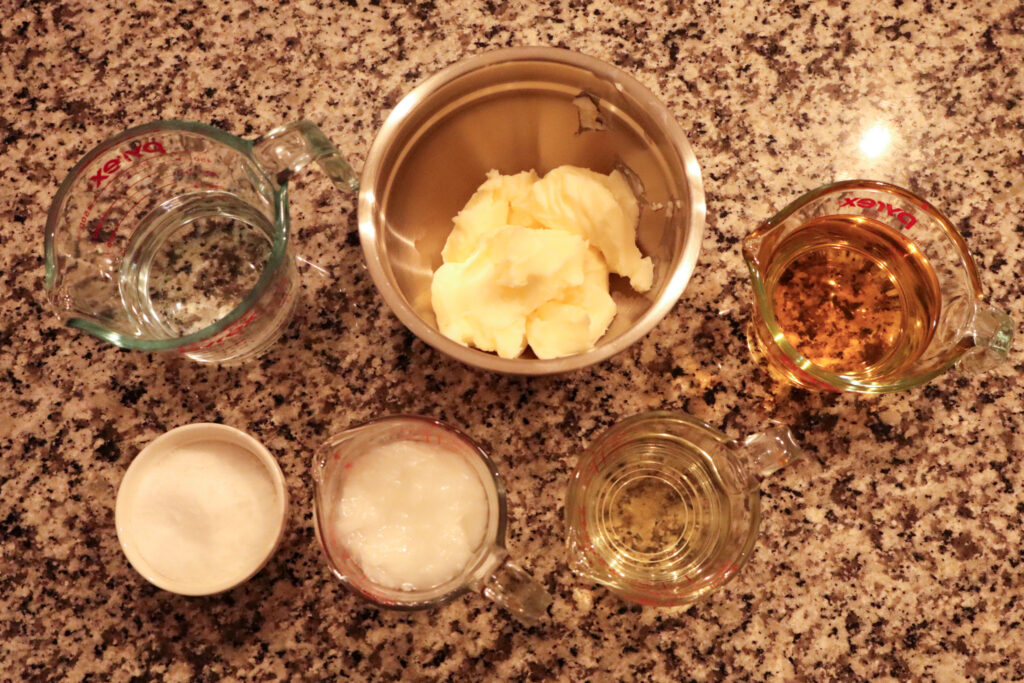
Distilled water
If you have a source of soft water then you can use that in place of the distilled water. You can also use hard water if you’d like, but it will shorten the life span of your soap bars due to the minerals in the water. You can counteract this by adding some citric acid, however, if you’re a new soaper I would simply use distilled water. It’s cheap.
For this recipe we will need 215g or 7.5oz
Lye
If you are going to make soap from scratch, you need lye. By adding the lye to our fats, a chemical reaction occurs that produces soap. If you’ve never worked with lye before, read through this post first.
We will be using 115g or 4oz
Avocado oil
If you’ve ever struggled with dry, broken hair avocado oil will become your hairs best friend. It moisturizes the hair and scalp helping to protect it against breakage. It’s also packed with fatty acids, vitamins and antioxidants. It’s high in palmitic acid and oleic acid. Both greatly benefit dry skin and hair. It can even aid in reducing inflammation.
For this recipe we will need 255g or 9oz
Castor oil
This is another deeply moisturizing oil high in ricinoleic acid. In fact, it’s one of the only oils we soapers can get our hands on that contains ricinoleic acid. This fatty acid moisturizes, is antimicrobial and anti inflammatory. If you have damaged hair and dry, irritated skin, castor oil is an ingredient you need to have on hand.
It also imparts a lovely luxurious lather to your soap 😀
We will need 170g or 6 oz
Coconut oil
This is where the cleansing action really kicks in. Coconut oil is high in lauric acid which is highly cleansing. In fact, if used in excess or without a sufficient super fat, coconut oil in soap can dry out your skin and hair. But, combine it with our very soothing, highly moisturizing fats, it produces a bar that makes beautifully bubbly soap.
We’re going to use 170g or 6oz
Beef tallow
I can’t get enough of tallow. It’s simply wonderful in the kitchen, bathroom, in body butter and soap bars. It is so economical to buy this in bulk where you’ll use it for cooking, baking, soaping, even as a balm for your wooden furniture and tools. It’s versatility is enough to love it, but it’s also packed with nourishing fatty acids and vitamins.
We will need 255g or 9oz
How to make this avocado and tallow shampoo bar recipe
Before beginning, ensure that all distractions are put away. Make sure that kids and pets are put away for their protection! If making soap during the day, only make it if another adult is able to watch the kids. Otherwise, waiting until after they are in bed for the night is a great option.
Weigh out ingredients
Our first step is to weigh out all of our ingredients. I like to weigh out my fats first, then the water, and finally the lye.
This way I can make my lye solution immediately. Lye is hygroscopic, meaning it’ll attract water from the air. Living in a humid climate means that the lye can get clumpy and that will affect the accuracy of our measurements. That can potentially lead to lye that’s not as efficient at turning fats into soap.
So, to ensure the purity of my lye, I do not leave it exposed to the air any longer than absolutely necessary.
Make your lye solution

Now that everything is weighed out, make your lye solution. Always add lye to water, never the other way around. Say this to yourself over and over to really nail this down, “snow falls on the lake”. Stir the lye water until the lye has fully dissolved.
It will get hot! Be careful not to inhale the fumes it produces at this time.
With that all done, set the lye solution in a safe place.
Combine the oils and fats

Add the oils/fats to a stainless steel pot/bowl. Melt the oils over medium low heat until everything is liquid. At this point check the temperature of your oils and lye solution. Our goal is to bring them within ten degrees or so of each other.
When working with lots of saturated fats, a higher temperature is ideal. Around 120-140 will be great. For the batch pictured below I combined the fats at 124F while the lye solution was 134F. If they are over 140F, let them cool off for a while longer before continuing.
Add lye solution to oils/fats

Gently pour the lye solution into the melted oils. You can pour over the shaft of your immersion blender to help reduce air bubbles in the batter. “Burp” your immersion blender to remove any air trapped under it’s bell.
Pulse your immersion blender for about twenty seconds, stir. Pulse and stir and pulse and stir until the batter has reached a thin trace.
You will want to be careful about over mixing this one. Any time you are working with lots of saturated fats, your soap batter will reach trace a lot quicker.
When thin trace is reached go ahead and add any essential oils you will be using. Make sure the essential oils you choose are safe for the skin and hair. Lavender is a great option, and one I’m kinda obsessed with 🙂 Whisk that in until it’s fully incorporated.
Pour soap batter into mold

If you’d like, you can spray the mold with a bit of rubbing alcohol. This is to help prevent soda ash formation. However, as long as your soap stays in the mold for 24+ hours you won’t have any unsaponified lye left to react with any carbon dioxide in the air.
Otherwise, gently pour the batter into the mold. Wiggle it around and bang it on the counter a few time to remove any air bubbles.
At this point you can decorate the top as desired.
Set aside the mold somewhere safe for the next 24 hours. You can also wrap the mold in a towel or blanket to trap in the heat as it saponifies. This will help it go through gel phase, which some believe helps to extend the life of your soap bars.
Cut your bars and cure
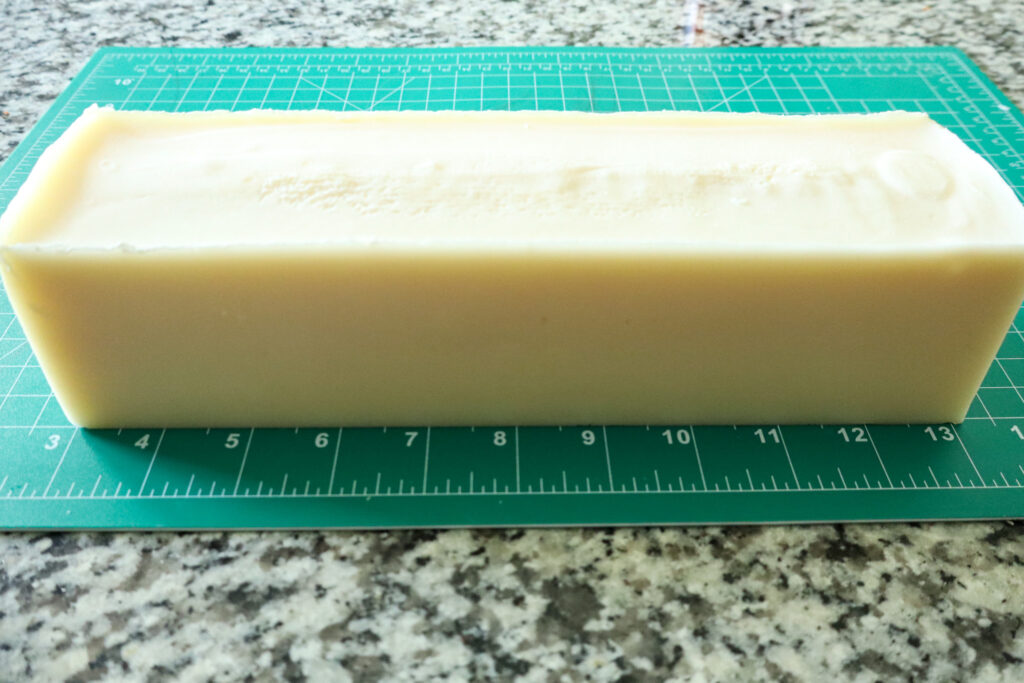
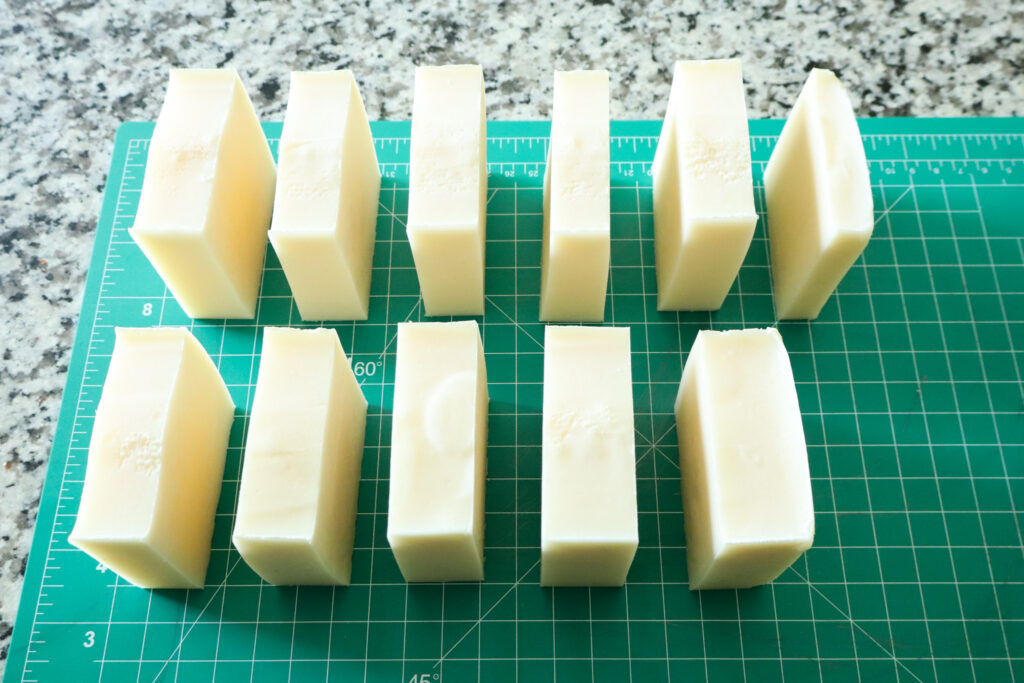
After 24 hours unmold your soap. Using a sharp knife or soap cutter, cut your bars so they are about an inch wide. If using this mold you should be able to get ten 1″ bars of soap, each weighing between 4-5oz before curing. As you can see from the picture, this doesn’t need to be perfect. Close enough will do 🙂
Set aside your bars in a well ventilated area out of direct sunlight. They will need to cure for at least four weeks before they are ready to use.
Viola! That’s it.
If you try out these bars let me know what you think in the comments below! My hair absolutely loves this soap, and I hope yours will too. 🙂
P.S. It’s always a good idea to follow the shampoo bars with an acidic rinse, especially when you first start using these avocado and tallow shampoo bars. Mix 1/4 cup of apple cider vinegar with 1-2 cups of water. Or take 1 tbsp citric acid with 1-2 cups of water.
***After using this soap recipe on my hair for over a year, I’ve edited it to increase the super fat to 6%
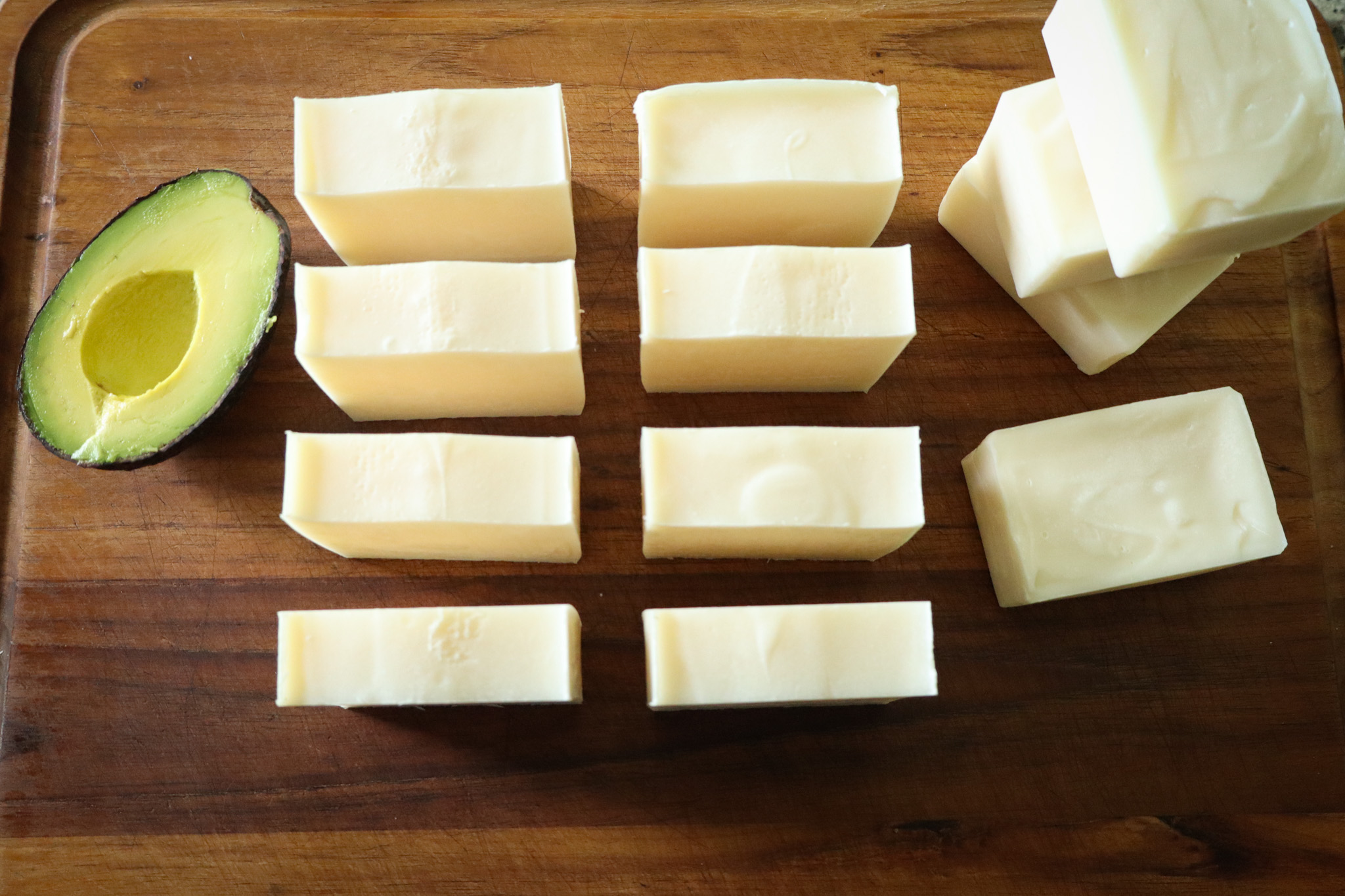

Avocado and Tallow Shampoo Bars
Ingredients
Equipment
Method
- Ensure you can work distraction free for a couple of hours. No kids or pets around while you are making soap! Work in a well ventilated area. Wear your protective gear!
- Weigh out all ingredients in separate containers. Use only containers that are non reactive to lye. Ceramic, heat proof glass, stainless steel, and thick plastic are great. Absolutely no aluminum products.
- Add lye to the water. "Snow falls on the lake"
- Stir with a stainless steel spoon until the lye has dissolved. Do not inhale the fumes produced during this process.
- Set aside in a safe place to cool.
- Combine all the oils and fats into a stainless steel pot or bowl. Heat over low-medium heat until all solids have melted.
- You want the lye solution and fats to be within ten degrees of each other before combining. A good temperature range is between 110-140. If the lye solution is still too hot (over 140F) allow it to cool further.If the oils are significantly cooler than the lye when they are fully melted, keep it over low heat until the lye has cooled more.
- Once the lye solution and oils are under 140F and within ten degrees of each other, add the lye solution to the oils. Pour over the shaft of your immersion blender to reduce air bubbles.
- Burp your immersion blender to release any air bubbles trapped under the bell. Pulse for a few seconds, then stir. Repeat until the mixture has fully emulsified and reached light trace. Trace is when the batter begins to thicken.
- Add in any essential oils, if using. Whisk those in until fully incorporated.
- Pour the soap batter into the mold. Wiggle it around and bang on the counter or floor to release any air bubbles.
- Decorate the top as desired.
- Spritz with isopropyl alcohol, if desired, to reduce the chances of soda ash formation.
- Optional. Wrap the mold in a towel or blanket to encourage the soap to go through a gel phase.
- Set aside in a safe place for 24-48 hours.
- Unmold your soap and cut into one inch wide bars.
- Set aside in a well ventilated area out of direct sunlight for 4-6 weeks before use.
Fantastic post on soap making! I make my own hot process shampoo bars but it has a few more ingredients, so I love how simple this is! I want to try this!
That sounds like so much fun! I’d love to try a hot process soap recipe 🙂
Thanks so much for sharing this! I’ve been wanting to try my hand at making soap and you’ve explained everything so well.
Thank you 🙂
Love the use of avocado oil in your recipe!
Hello can I substitute chicken fats for Beef Tallow
You will need to run it through a lye calculator. I use soapcalc.net. Love the idea of using chicken fat, though!
Thank you for such an informative post! I have been wanting to try my hand at making my own soaps and shampoo bars. This sounds so user friendly! I have been using all natural products for a couple of years and am looking for ways to be more frugal. This really helps! 🩷
I’m so glad you found it helpful!
Do you hav a recipe for a shampoo bar that does not have coconut oil? A friend’s daughter is allergic and they would love some shampoo bars.
Thank you, Theresa
I don’t have a dedicated shampoo bar recipe without coconut oil yet, but I’ll definitely get to making one ASAP. For the meantime I do have a recipe for 100% tallow soap that would work just as well and is super allergy friendly. Hope that helps ☺️